In Waldorf education, handwork is much more than simply knitting and sewing; it is a developmental journey that supports children intellectually, socially, and emotionally. From the first tentative stitches in Class 1 to the confident sewing-machine work of Class 8, each year’s projects meet students where they are in their development, strengthening their dexterity, focus, creativity, and sense of self.
What are the nuts and bolts of Handwork? Research shows a strong link between fine motor skills and brain development. The New York Times published an article in 2019, titled “Your Surgeon’s Childhood Hobbies May Affect Your Health,” addressing how medical schools are noticing a decline in students’ dexterity, possibly from spending too much time swiping screens rather than developing fine motor skills through woodworking and sewing. There is now an initiative called “Sewing for Surgeons” in North Carolina, teaching pre-med students how to sew. So, let’s take a light stroll through the handwork curriculum.
Handwork activities like knitting, sewing, crochet, weaving, and cross-stitch activate both hemispheres of the brain, building skills such as:
- Eye tracking (important for reading)
- Spatial awareness
- Crossing the midline
- Mathematical thinking (counting, patterning, measuring)
Handwork also nurtures patience, perseverance, and problem-solving. Students learn to notice mistakes, fix them, and take pride in their progress. These experiences naturally foster a growth mindset, awakening a qualitative outcome rather than a quantitative outcome.
Using natural materials such as wool, cotton, wood, and silk helps children feel connected to the living world and adds warmth and meaning to their work.
While handwork often requires quiet concentration, it is also very much a social practice. Children sit together, chatting, sharing ideas, and helping one another. At the Constantia Waldorf School, our Class 7s buddy up with our Class 1s, teaching every child how to knit.
The handwork journey begins in Class 1 with making their own handwork bags after which they move onto knitting. Our Class 1s learn the basics, casting on and knitting, building finger dexterity. Projects range from butterflies to recorder bags.
In Class 2, the children contiue to knit, finish their recorder bags, and create a stuffed gnome, an animal and finally a knitted doll family. Here they work more deeply into pattern recognition and learn to follow more complex instructions.
Our Class 3 students learn to weave on looms and to crochet.
Cross-Stitch and embroidery is the handwork challenge for the Class 4 student. Through cross-stitch and embroidery, they are challenged to draw their first patterns and create a symmetrical, self-designed piece. This process supports spatial awareness, math skills, and a growing sense of personal identity.
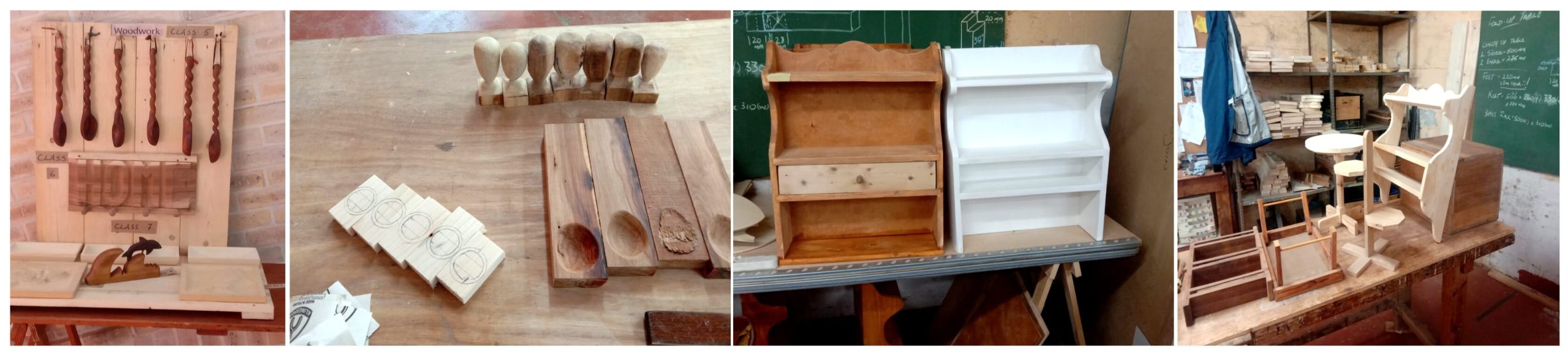
In Class 5, they design and knit in ‘the round’, using double-pointed needles and knitting their own beanie, and for those speedy knitters a pair of bed socks, creating their first wearable garments. They also begin woodworking in Class 5 tackling projects focused on three-dimensional thinking, learning how to shape an egg, after which they make a salad spoon and fork. Students learn to understand symmetry, convex, and concave lines.
Class 6s design and sew beautifully constructed african animals, learning about form and proportion and they also make their first doll. Their woodworking lessons mirror this challenge, with the students learning how to carve a coat rack for their homes.
The Class 7 students begin exploring clothmaking, and learn to make their own felted sheets and produce slippers from it. This is also the year the Class 7s work collaboratively in producing a sizable gift for their Class Teacher, as a parting gift at the end of their Primay School journey. In Woodwork, our students carve bowls paying careful attention to the angles and gestures of carving, a practice that naturally reinforces their emerging math and science capacities.
When they move into High School, they deepen their sewing skills, learn to read a pattern, take accurate measurements, understand fabric grain and make their own hoodie. They also produce a collapsible breakfast table and a spice rack for their woodwork projects.
Through every stage, handwork develops much more than craft. It builds confidence, coordination, focus, creative problem-solving, and develops a sense of capability. With every stitch, students weave together practical skills and inner growth, strengthening head, heart, and hands in equal measure.
Reference: The article above is a summary of the “Handwork through the grades in Waldorf Education By Gayla Overmeer, Handwork teacher Live Oak Charter School”. Adapted to what is offered at the Constantia Waldorf School, in line with the curriculum.